Dolphin Semiconductor’s clock and timing IP portfolio brings accurate clock, time and calendar functions to always-on (AON) domains. Nano-power operation keeps consumption to a minimum for longer battery life, and a wide range of products across many technology nodes lets designers select the right one for their specific needs.
Radio front-end for the Bluetooth link to the phone and the second earbud.
ROM / OTP
Boot code and one-time-programmable trimming and configuration data.
PLL + XO
High-freq. clock
High-frequency clock for the radio and CPU. Switched off in sleep, when the 32 kHz oscillator takes over timekeeping.
Audio Codec
ADC · DAC · Mic bias
Microphone capture and audio playback conversion.
Headphone Driver
Class-D / Class-AB
Drives the earbud speaker.
BT Baseband
Modem · Link Layer
Bluetooth modem and link layer. Relies on an accurate sleep clock to keep receive windows short.
Application CPU
Arm Cortex-M
Runs the application and the Bluetooth stack.
Peripherals
I²S · I²C · UART · GPIO
Digital interfaces to sensors, buttons and the host.
SAR ADC
Touch / Sensor IF
Converts touch and sensor signals.
32 kHz Oscillator
XTAL · RC · RC LD
Nano-power clock that keeps running while the rest of the SoC sleeps. It times BLE sleep intervals, wake-up events and the real-time clock. In TWS earbuds, a low-drift RC removes the crystal while keeping BLE timing accurate.
SRAM
Program and audio buffer memory.
Audio DSP
ANC · ENC · EQ
Noise cancellation, voice enhancement and equalisation.
Battery Charger
Charges the earbud battery from the case.
Always-On
RTC · Wake-up
Real-time clock and wake-up logic, clocked by the 32 kHz oscillator.
PMU
Buck · LDO · POR
Power supplies and power-on reset. Keeps the always-on domain powered during sleep.
Hover or select a block to see its role.
Hover or select a block to see its role.
Example of a TWS SoC with an oscillator in the always-on (AON) domain. Illustrative floorplan, not to scale.
What is clock and timing IP?
Clock and timing IP is a clock-generation circuit designed for the always-on (AON) domain of battery-powered devices, where minimal power consumption is key to the longest battery life. A wide range of implementations lets designers find the best trade-off between accuracy, startup time, power consumption and bill-of-materials (BOM) cost.
Crystal (XTAL) oscillators deliver the accuracy required by the most demanding applications. RC oscillators start up faster while significantly reducing power consumption and BOM cost. Low-drift RC oscillators take the performance to the next level and narrow the accuracy gap with crystals, while keeping the BOM cost and PCB footprint savings of an RC design.
High accuracy
XTAL and low-drift RC
Nano-power
Always-on operation
Fast startup
RC oscillator wake-up
Figures are Dolphin design targets and silicon measurements published in the IP Catalog 2026.
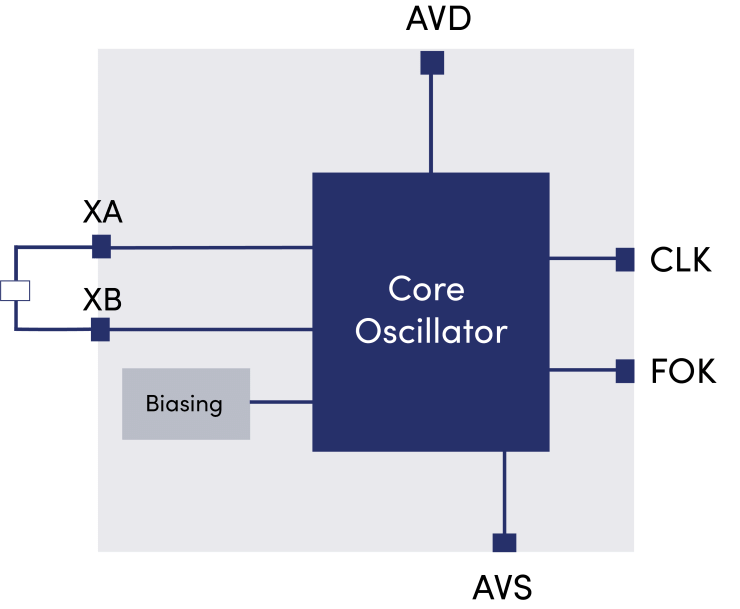
XTAL-based oscillator
Accuracy
Core Oscillator Generates the clock delivered to the always-on domain.
AVD Analog supply of the oscillator.
AVS Analog ground of the oscillator.
CLK Clock output to the always-on domain (RTC, wake-up timers, BLE sleep clock).
FOK Frequency OK: tells the SoC the clock is stable and safe to use.
XA Crystal pin. The external crystal connects between XA and XB.
XB Crystal pin. The external crystal connects between XA and XB.
Crystal reference External quartz crystal that sets the frequency accuracy. Adds BOM cost and two pins.
Biasing Sets the operating current of the core oscillator.
High frequency accuracy from an external crystal
Low drift over temperature and aging
Best fit for precise RTC / calendar keeping
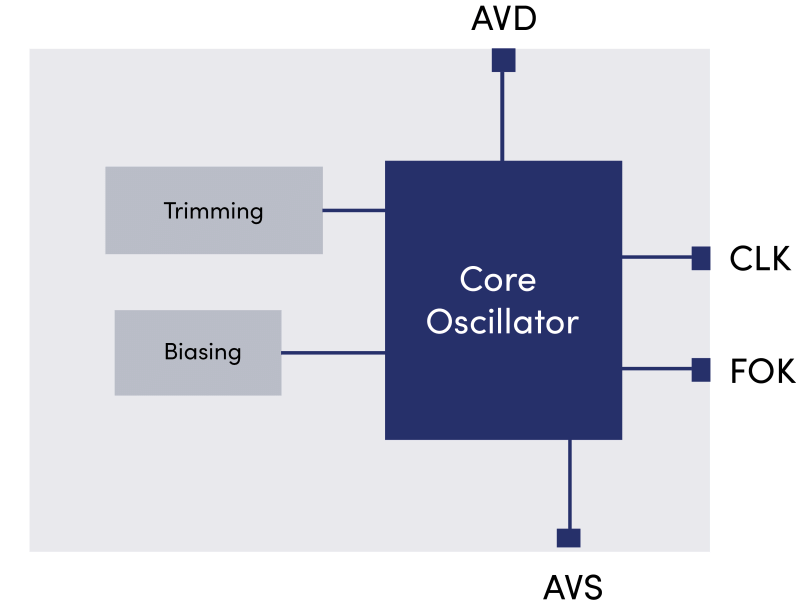
RC oscillator
Quick startup, low power & low BOM cost
Core Oscillator Generates the clock delivered to the always-on domain.
AVD Analog supply of the oscillator.
AVS Analog ground of the oscillator.
CLK Clock output to the always-on domain (RTC, wake-up timers, BLE sleep clock).
FOK Frequency OK: tells the SoC the clock is stable and safe to use.
Trimming On-chip frequency trimming for good accuracy without a crystal.
Biasing Sets the operating current of the core oscillator.
No external crystal: zero added BOM cost
Smallest PCB and pin footprint
On-chip trimming for good accuracy
RC LD (low-drift) variant available
XTAL vs. RC oscillator architecture. Hover a block or pin to see its role.
Which oscillator fits your design?
Select an approach to compare the trade-off.
Crystal (XTAL) oscillators deliver the accuracy required by the most demanding applications.
Best suited to
Smart metersSmartwatches with a time displayMedical and industrial data loggersBLE devices with long sleep intervals
Accuracy · Highest
Power · Higher
Startup · Slower
BOM cost · External crystal
Relative comparison between the three approaches.
RC oscillators start up faster while significantly reducing power consumption and BOM cost.
Best suited to
Watchdog and wake-up timersRemote controls and key fobsLow-cost IoT sensor nodesDisposable devices such as patches and smart labels
Accuracy · Lower
Power · Lowest
Startup · Fastest
BOM cost · No crystal
Relative comparison between the three approaches.
Low-drift RC oscillators narrow the accuracy gap with crystals, while keeping the BOM cost and PCB footprint savings of an RC design.
Best suited to
TWS earbudsHearing aidsAsset trackers and tagsFitness bands
Accuracy · Near-crystal
Power · Low
Startup · Fast
BOM cost · No crystal
Relative comparison between the three approaches.
Key features
What does this clock and timing IP deliver?
Five capabilities that make the clock, time and calendar function reliable across process, voltage and temperature.
High Accuracy
XTAL operation, or RC calibrated against an XTAL reference, for tight frequency tolerance.
Target application: Smart meters, smartwatches, data loggers
Nano-Power Consumption
Nano-power operating point for continuous always-on timekeeping.
Configurable to a broad range of external crystal specifications.
Target application: Multi-platform SoC reuse
Bypass Mode
Drives the clock tree directly from an external source for fast production test.
Target application: ATE test time reduction
Frequency OK (FOK) Signal
Tells the rest of the SoC that the oscillator output is stable and safe to use, during startup or after a clock failure.
Target application: Safe power-up sequencing
Applications
Which end applications does this clock and timing IP enable?
Each application has different constraints when it comes to accuracy, power consumption or startup time. Those trade-offs can be targeted by selecting the right oscillator IP.
Application
Why this choice
Smart meters
XTAL
The calendar must stay accurate over years of operation without resynchronization.
Smartwatches with a time display
XTAL
The user sees clock drift directly, so ppm-level accuracy is needed.
Medical and industrial data loggers
XTAL
Timestamps must be precise and traceable.
BLE devices with long sleep intervals
XTAL
An accurate sleep clock keeps the receive window small, which saves radio power.
Watchdog and wake-up timers
RC
Only a periodic tick is needed, so the lowest power and fastest startup matter most.
Remote controls and key fobs
RC
The device sits idle most of the time, and cost and size dominate over accuracy.
Low-cost IoT sensor nodes
RC
A coarse wake-up schedule is enough, and removing the crystal cuts BOM cost.
Disposable devices such as patches and smart labels
RC
The lowest BOM cost and smallest footprint are essential.
TWS earbuds
Low-drift RC
Space is extremely tight, but the BLE timing still needs good accuracy.
Hearing aids
Low-drift RC
The form factor is very small and the battery life must be long, which leaves no room for a crystal.
Asset trackers and tags
Low-drift RC
Cost and size are critical while BLE connectivity must stay reliable.
Fitness bands
Low-drift RC
Timekeeping is acceptable without a crystal, saving PCB area and cost.
FAQ
Frequently asked questions about Dolphin clock and timing IP
What's the difference between the XTAL and RC oscillators?
The XTAL oscillator delivers the accuracy the most demanding applications need. The RC oscillator trades some accuracy for much faster startup, lower power consumption and lower bill-of-materials (BOM) cost. Dolphin’s low-drift RC oscillators (RC LD) narrow the accuracy gap with crystal oscillators while keeping the BOM cost and footprint savings of an RC design. The two can also work together: the RC runs continuously and is periodically calibrated against the XTAL, which only needs to be switched on briefly. The result is near-crystal accuracy at a fraction of the average power.
What does the Frequency OK (FOK) signal do?
The FOK signal tells the rest of the SoC that the oscillator output is stable and safe to use, preventing downstream logic from running on an unstable clock during startup or after a clock failure.
How does the licensing model work?
Dolphin licenses per project, with the option of per-unit royalties depending on the volume. A licence covers the deliverable set needed for integration: views, models, documentation and integration support. Terms are set with the field engineering team during the technical evaluation.
Can this block be evaluated before licensing?
Yes. Dolphin’s Application Lab supports pre-licence technical evaluation, including characterisation data review and integration feasibility on the target node. Requests go through the support channel below.
Can the clock and timing IP be customised for my node?
Yes. Crystal range, bypass mode and calibration strategy are configurable, and Dolphin’s design teams adapt the block to a target node when the off-the-shelf configuration does not fit.
To provide the best experiences, we use technologies like cookies to store and/or access device information. Consenting to these technologies will allow us to process data such as browsing behavior or unique IDs on this site. Not consenting or withdrawing consent may negatively affect certain features and functions.
Functional
Always active
Technical access or storage is strictly necessary for the legitimate interest purpose of enabling the use of a specific service explicitly requested by the subscriber or user, or solely for the purpose of transmitting a communication over an electronic communications network.
Préférences
L’accès ou le stockage technique est nécessaire dans la finalité d’intérêt légitime de stocker des préférences qui ne sont pas demandées par l’abonné ou l’internaute.
Statistics
Le stockage ou l’accès technique qui est utilisé exclusivement à des fins statistiques.Technical storage or access that is used exclusively for anonymous statistical purposes. In the absence of a subpoena, voluntary compliance by your internet service provider, or additional records from a third party, information stored or retrieved solely for this purpose cannot generally be used to identify you.
Marketing
Technical access or storage is necessary to create user profiles for advertising purposes or to track the user on a website or across multiple websites for similar marketing purposes.